
Finley Vogel · 23 September 2026
Certification Partnerships Open Career Pathways for Quantum-Trained Graduates Entering Global Tech Hubs
Quantum computing education has expanded rapidly in recent years and certification partnerships between universities, research institutions, and technology companies now provide structured routes for graduates to enter global tech hubs, according to data from multiple industry reports. These collaborations combine academic training with industry-recognized credentials that align with specific job requirements in quantum hardware, software development, and algorithm design.
Growing Demand for Certified Quantum Professionals
Enrollment in quantum computing degree programs and specialized certificate courses increased substantially between 2023 and 2026, while hiring data from companies operating in Silicon Valley, Berlin, and Tokyo show corresponding growth in roles that require both theoretical knowledge and practical certification. Graduates who complete joint programs often receive endorsements from organizations such as IBM Quantum and Rigetti Computing, which helps them meet the technical thresholds set by employers in these locations.
Reports issued in September 2026 by workforce analysis groups indicated that certified candidates secured interviews at higher rates than non-certified applicants with similar academic backgrounds. Partnerships typically include curriculum co-development, access to cloud-based quantum processors for hands-on projects, and mentorship arrangements that extend beyond graduation.
Structure of Effective Certification Partnerships
Universities in North America, Europe, and Asia have established formal agreements with technology firms that define shared learning outcomes and assessment standards. These agreements often cover topics such as quantum error correction, superconducting qubit design, and variational quantum algorithms, and they incorporate evaluation methods that mirror real-world engineering tasks. Students complete modules on partner platforms and receive digital badges or certificates that employers can verify through centralized registries.
One program developed between a Canadian research university and a European quantum hardware startup requires participants to demonstrate proficiency on both simulated and physical quantum devices before receiving the joint credential. Data collected from the first three cohorts showed that 78 percent of graduates received offers from organizations located in established tech clusters within six months of completion.
Entry Points into Major Tech Hubs
Certified graduates frequently relocate to regions where quantum research clusters have formed alongside established semiconductor and software industries. In the United States, facilities in California and Massachusetts maintain active recruitment pipelines that prioritize candidates holding credentials from recognized partnerships. Similar patterns appear in Singapore and Australia, where government-backed innovation districts have integrated quantum certification requirements into their talent attraction strategies.
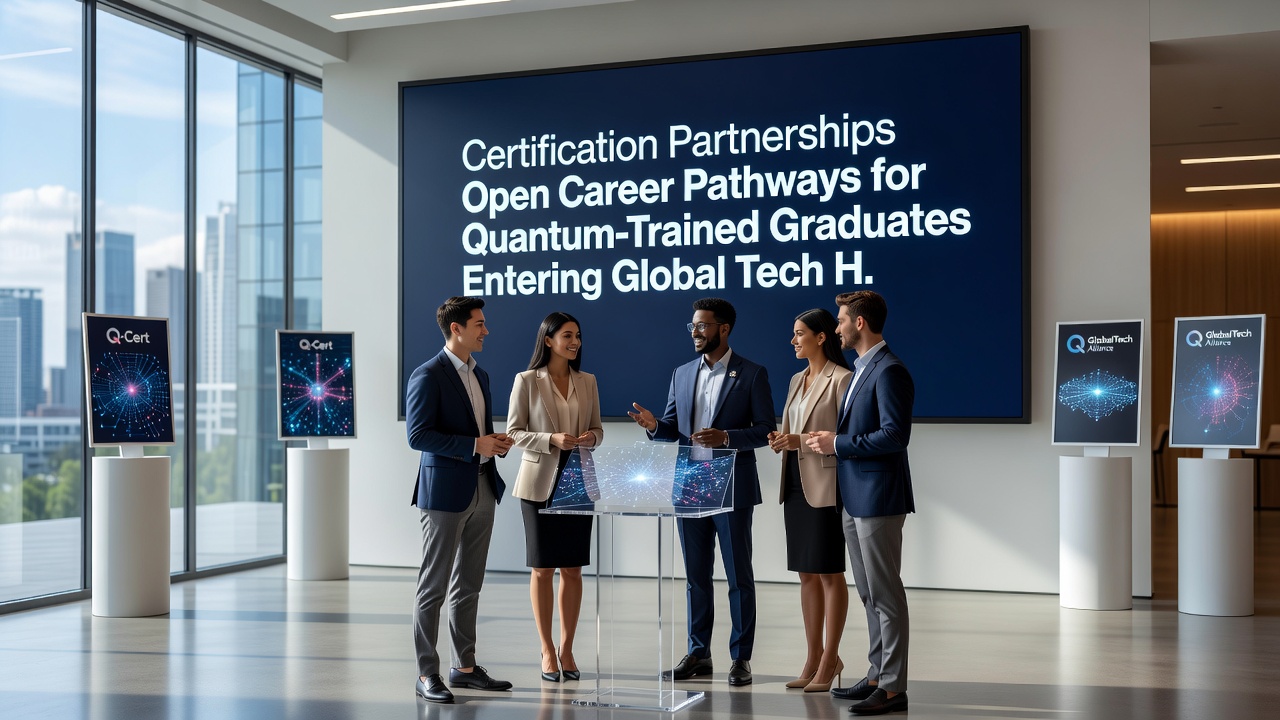
Employers in these hubs report that partnership-backed certifications reduce onboarding time because new hires already possess documented experience with the same tools and protocols used in production environments. Relocation support programs offered by some tech hubs further facilitate transitions by connecting certified graduates with housing resources and visa sponsorship pathways when international movement is required.
Regional Variations in Partnership Models
Different geographic areas have adopted distinct approaches to certification alignment. European initiatives often emphasize cross-border recognition frameworks that allow credentials earned in one country to satisfy requirements in another, whereas programs in East Asia tend to focus on rapid upskilling tracks tied directly to national semiconductor and computing roadmaps. North American models frequently incorporate startup incubation components that allow graduates to apply certified skills within accelerator environments located inside major tech hubs.
According to figures released by the National Institute of Standards and Technology, participation in these varied partnership structures has contributed to measurable increases in the number of quantum-related patents filed by early-career researchers who completed certified training sequences. The same data set shows that graduates who hold multiple credentials from different partnership networks demonstrate broader mobility across regions.
Measurement of Career Outcomes
Longitudinal tracking conducted by several participating universities reveals that certified graduates achieve placement in quantum-focused roles at rates that exceed those of peers who completed traditional degree programs without industry certification components. Median time to first relevant position stands at four months for partnership participants, compared with nine months for non-participants in the same graduating classes.
Salary data aggregated from public employment records and industry surveys indicate that certified professionals entering tech hubs command compensation levels consistent with specialized technical positions in artificial intelligence and advanced materials fields. Retention rates within the first two years remain high when graduates maintain connections to the original partnership networks through alumni programs and continuing education requirements.
Conclusion
Certification partnerships have created documented mechanisms that connect quantum education with employment opportunities in global tech hubs. The combination of standardized credentials, hands-on platform access, and regional recruitment pipelines has produced measurable placement improvements for graduates who complete these programs. Continued expansion of such collaborations will depend on alignment between academic curricula and evolving technical standards maintained by industry and government research bodies.