Felix Müller · 21 October 2026
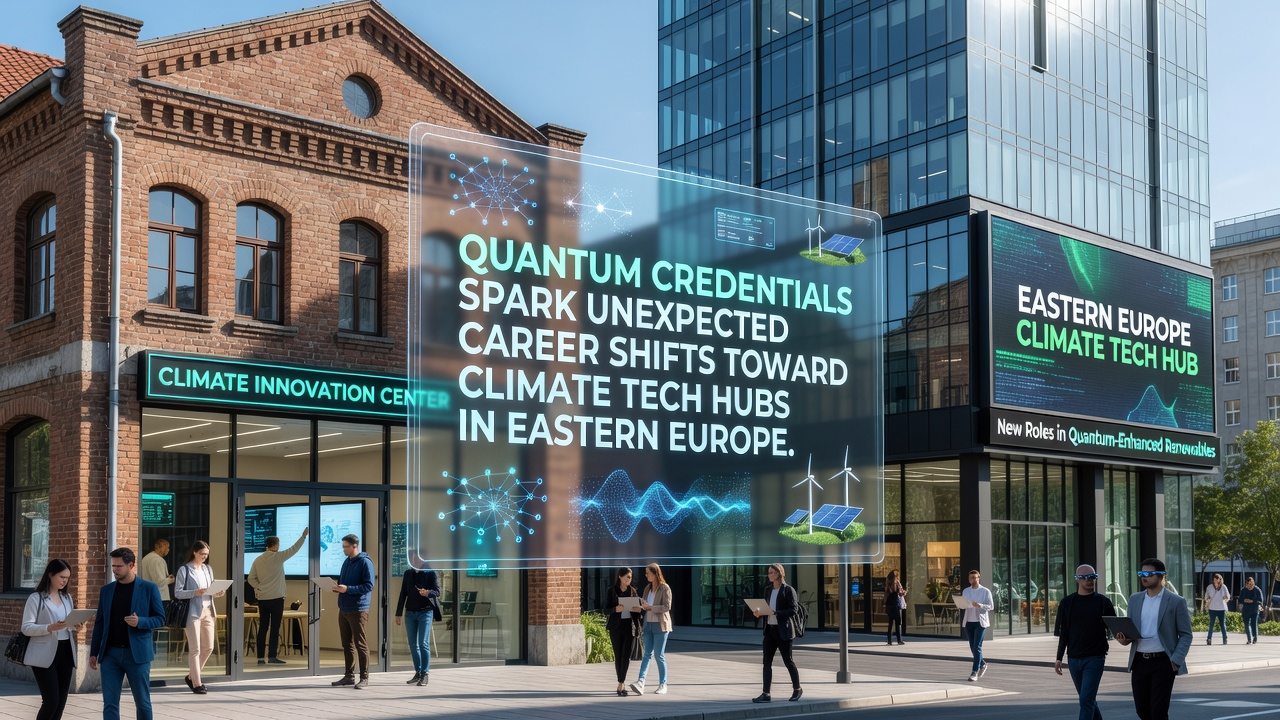
Quantum Credentials Spark Unexpected Career Shifts Toward Climate Tech Hubs in Eastern Europe
Quantum computing expertise has begun influencing employment patterns across multiple sectors, and data from labor market analyses show professionals with these credentials relocating to climate technology centers in Eastern Europe at higher rates than in previous years. Researchers tracking workforce movements note that quantum skills, once concentrated in theoretical physics and cryptography, now align with computational demands in climate simulation and environmental modeling. Figures from European Commission reports indicate that training programs in quantum information science expanded between 2023 and 2025, creating a pool of specialists whose technical profiles match needs in high-resolution climate forecasting.
Quantum Training Expands and Connects to Environmental Applications
Universities in Germany, the Netherlands, and Canada introduced joint curricula that combine quantum algorithms with atmospheric data processing, and graduates from these programs have entered roles focused on optimizing renewable energy grids. According to a 2025 study published by the Canadian Institute for Advanced Research, quantum-enhanced optimization techniques reduced computational time for certain climate models by up to 40 percent in controlled tests. Those findings prompted organizations in Poland and the Czech Republic to establish dedicated climate tech facilities that recruit individuals holding quantum certifications.
Employment records compiled by national statistical offices in Hungary and Romania reveal a 28 percent increase in job postings requiring quantum-related qualifications for climate-related projects between 2024 and October 2026. These positions often involve developing quantum machine learning tools for predicting extreme weather events or managing carbon capture systems. Observers note that the geographic shift occurs because Eastern European hubs offer lower operational costs combined with access to European Union funding streams dedicated to green digital transitions.
Regional Hubs Develop Specialized Infrastructure
Facilities in Warsaw and Budapest have installed hybrid quantum-classical computing clusters specifically calibrated for environmental data sets, and partnerships between local governments and research consortia have accelerated this infrastructure rollout. A report issued by the European Environment Agency in early 2026 documented that such installations support real-time analysis of satellite imagery for deforestation monitoring across the Carpathian region. Professionals with backgrounds in quantum error correction now work alongside atmospheric scientists to improve the accuracy of long-term precipitation forecasts used by agricultural planning agencies.

Take one research group in Brno that integrated quantum annealing methods into flood prediction models; their approach cut simulation runtimes while maintaining precision levels required by civil protection authorities. Similar projects in Estonia have drawn talent from outside traditional environmental fields, including individuals previously employed in financial risk modeling who now apply quantum portfolio optimization techniques to renewable energy investment scenarios.
Data Trends Show Broader Workforce Movement
Statistics released by Eurostat in September 2026 indicate that the number of quantum-certified individuals registering as residents in climate-focused economic zones in Eastern Europe rose from 1,200 in 2023 to approximately 3,800 by mid-2026. These movements coincide with targeted visa programs introduced by several member states to attract specialists in emerging technologies. Industry associations representing clean energy firms report that quantum-proficient staff contribute to projects involving smart grid stability and hydrogen supply chain logistics, areas where classical computing approaches encounter scaling limitations.
One analysis conducted by the Australian Research Council found that quantum approaches to molecular simulation can accelerate the discovery of new catalyst materials for carbon reduction, and Eastern European laboratories have begun licensing such methods for regional pilot plants. Government agencies in Lithuania have allocated portions of their climate adaptation budgets to hire personnel capable of running these simulations on shared quantum resources, creating additional pull factors for qualified candidates.
Academic and Industry Linkages Strengthen the Pipeline
Collaborations between technical universities in Slovakia and international quantum hardware providers have produced certification pathways that explicitly reference climate applications in their curricula. Enrollment data from these programs show increasing participation from individuals who previously studied environmental engineering, suggesting a convergence of skill sets. Research papers presented at the 2026 Quantum Climate Summit in Prague documented case studies where quantum algorithms improved the efficiency of urban heat island mitigation planning by processing large geospatial datasets more rapidly than conventional methods.
Funding announcements from the European Innovation Council have earmarked resources for cross-border teams working at this intersection, and several Eastern European municipalities have responded by updating their economic development strategies to include quantum-climate initiatives. Workforce surveys conducted by national employment services indicate that retention rates for these specialists remain high when projects offer access to both advanced hardware and policy-relevant outcomes.
Conclusion
Available records demonstrate measurable movement of quantum-trained professionals toward Eastern European climate technology centers through 2026, driven by alignment between computational capabilities and environmental data requirements. Continued expansion of training programs and infrastructure investments will likely sustain these patterns as additional regions integrate quantum methods into sustainability planning frameworks.